
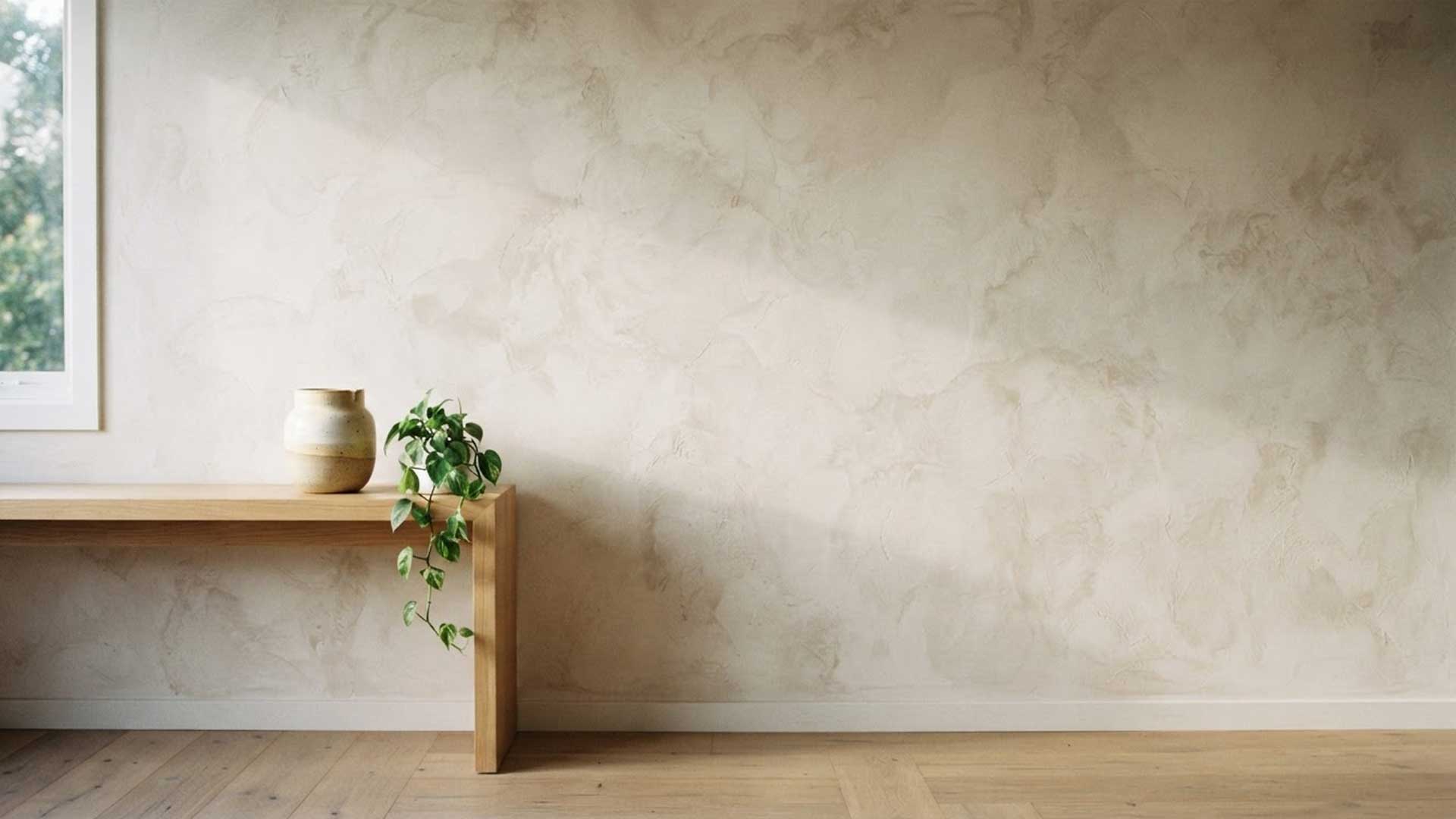
Roman Clay is priced per project rather than by a flat rate per square foot. Four things move the number more than anything else: how much prep your walls need, the size and layout of the space, how many coats it takes to reach even coverage, and whether you add a sealed topcoat. Once you can see those four in a quote, the total stops looking arbitrary.
You will find per square foot averages published online. They are useful as background reading and poor as a budget. Roman Clay is applied by hand, and the labor side shifts with wall condition, ceiling height, room geometry, and local rates. A figure pulled from a national average can miss a specific project by a wide margin in either direction.
Surface Prep Is Usually the Largest Variable
Roman Clay needs a smooth substrate, and Level 5 drywall is the target. If your walls carry an existing texture such as orange peel or knockdown, or have patches and damage, that surface has to be skim coated and sanded flat before any Roman Clay goes on.
Prep is real work with its own material and its own hours, so it belongs on the quote as its own line rather than folded into the finish. Two rooms of identical square footage can land at very different totals purely on wall condition.
Coats and Coverage
Standard application is two coats: a heavier base coat, then a lighter final coat that brings out the movement in the finish.
Portola sells Roman Clay by weight and lists coverage at roughly 20 to 25 square feet per kilo for two coats. Portola also notes that coverage varies with how porous the surface is, so treat the range as a planning figure rather than a guarantee. Larger rooms and more complex layouts use proportionally more material and more hours.
Deep, saturated colors and uneven substrates sometimes need an extra pass to read evenly, which adds both material and labor.
Sizing the material yourself
Measure wall height by width, subtract large openings, then divide the square footage by 20 to 25 to get the kilos needed for two coats. A wall that runs 10 ft wide by 10 ft tall is 100 square feet, which works out to about 4 to 5 kilos. That covers the material side only, not labor, but it gives you a reference point when you read a quote.
Sealer and Topcoat
Roman Clay Topcoat is a separate, thin coat applied over the fully cured finish. It leaves a wipeable surface with a light sheen, which is worth having in bathrooms, hallways, and other rooms that get touched often.
Because it is its own product and its own application step, it is quoted as an add on. Many bedroom and dining room walls do not need it.
Room Type and Layout
An accent wall and a full open plan living area are different jobs even at similar square footage. Corners, windows, doors, and built ins all mean more cutting in, more edges to protect, and more time on site.
Ceilings above the usual 8 to 9 ft add both material and labor, since the work moves off the floor.
How We Quote: Labor and Materials
We quote Roman Clay as labor, and the Portola material is purchased separately.
The reason is straightforward. If a wall needs a third pass because of the color or the substrate, that shows up as material, where you can see it, instead of sitting inside a padded labor figure.
If you are comparing more than one quote, check which model each one uses. A labor only number and a labor plus materials number are not describing the same thing, even when the finished wall would look identical.
What a Roman Clay Quote Should Spell Out
Whoever you hire, a quote worth signing should be specific about the following:
- The prep scope: which walls get skim coated, how many passes, and what condition the surface will be in before the finish starts.
- The square footage being covered, listed wall by wall or room by room.
- How many coats are included, and what happens if the color needs another pass.
- Whether Topcoat is included, and on which surfaces.
- Whether the price is labor only or includes the Portola material.
- Protection and cleanup: floors, furniture, and fixtures.
Frequently Asked Questions
Why is there no set price per square foot for Roman Clay?
Because the labor varies so much with wall condition, ceiling height, room layout, and local rates. A flat rate has to assume all of those, and any project that does not match the assumption gets mispriced. Quoting after seeing the walls avoids that.
Does a darker Roman Clay color cost more?
It can. Deep, saturated colors sometimes need an extra pass to read evenly, which adds both material and labor.
Is the topcoat included in a Roman Clay quote?
Not by default. It is a separate product and a separate application step, so it is quoted as an add on for the rooms that need it.
Does Roman Clay cost more than paint?
Yes. It needs a smooth substrate, it is applied by hand, and it takes at least two coats, so both the prep and the application take longer than a standard repaint.
Every set of walls is different. Request a free estimate and we will walk the space and put the prep, the coats, and the topcoat in writing before any work starts.